Chapter 3
🌱 Step 1: Start with your connections
While data centers can feel unrelated, students are interacting with them constantly, through streaming, gaming, cloud storage, and AI tools. According to the International Energy Agency, demand for these services is a major driver of rising data center energy use.
Reflection:
What apps or technologies do you use every day that rely on data centers?
Step 2: Find your angle of interest
Students from different backgrounds will connect to different aspects:
Environmental interest → climate and energy
Tech interest → servers, AI, efficiency
Civic interest → local development and policy
Social interest → community impacts
Reflection:
Which part of this issue feels most relevant or interesting to you?
Step 3: Look locally!
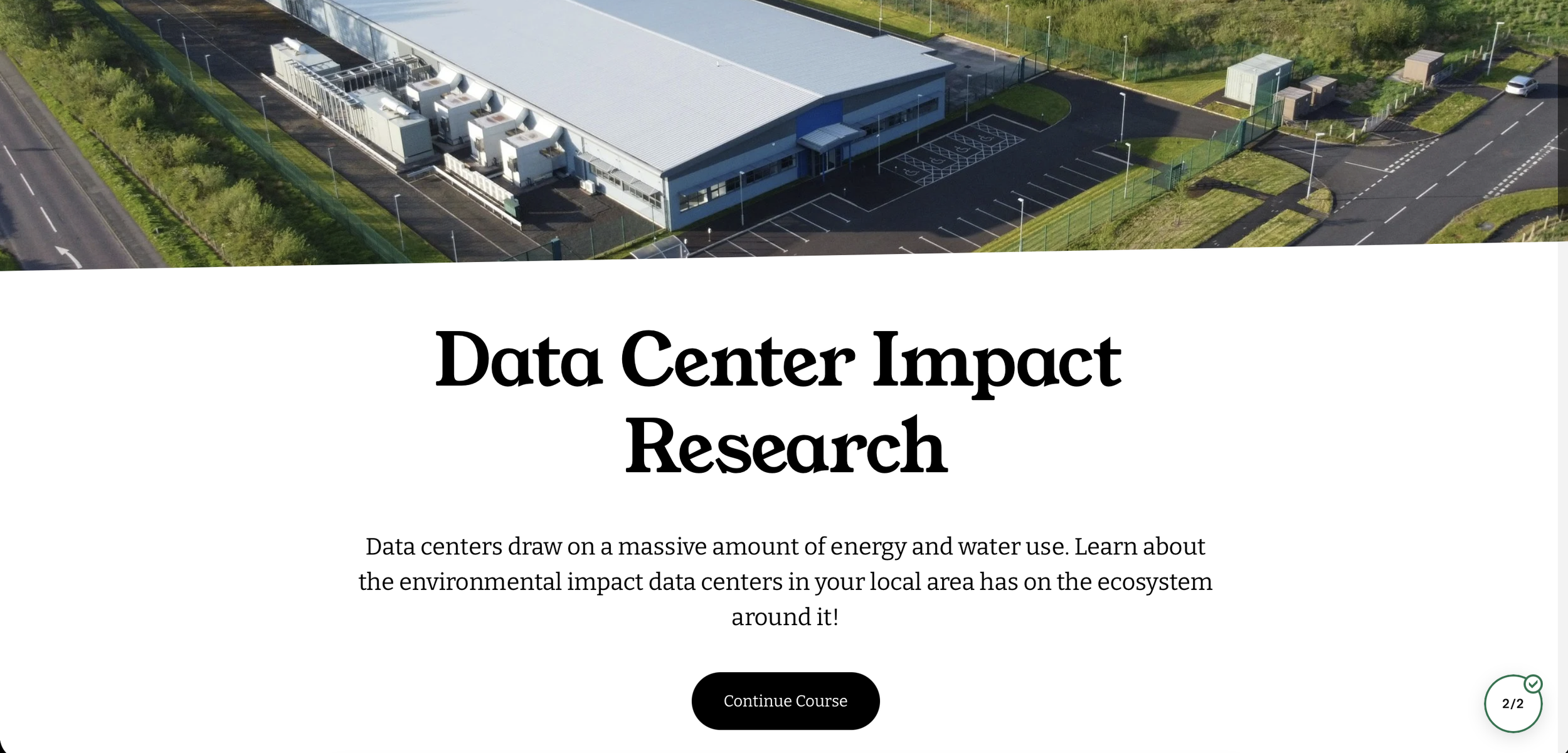
Even if students do not realize it, many regions are seeing new data center development, with data centers significantly affecting local electricity and water systems.
Look up whether data centers exist or are planned nearby
Explore local news or city council decisions
Ask how energy and water are being used
Reflection:
Is anything like this happening in your area, or nearby cities?
Step 4: Connect with organizations

Sierra Club: Sierra Club is actively working to ensure data centers grow responsibly by pushing for regulations that require tech companies to pay for their own energy infrastructure, rather than shifting costs to consumers

Sunrise Movement: In early 2026, the Sunrise Movement launched a national campaign to halt the expansion of new data centers, arguing they drive up energy demand, cause pollution, and strain water resources
.
World Resources Institute: The World Resources Institute (WRI) is actively addressing the rapid growth of data centers by focusing on their environmental, energy, and community impacts, aiming to ensure this digital infrastructure expansion aligns with sustainability goals..
Step 5: Conduct your own research & recommendations!
Follow GTI’s research fellowship to produce research papers and proposals!
Do you want to gain rigorous research experience with our experienced staff?